A clinic rarely notices a marketing problem as a marketing problem. It notices a quiet Tuesday, or a new patient who says something strange at the desk, or a competitor two streets away who suddenly seems to be everywhere.
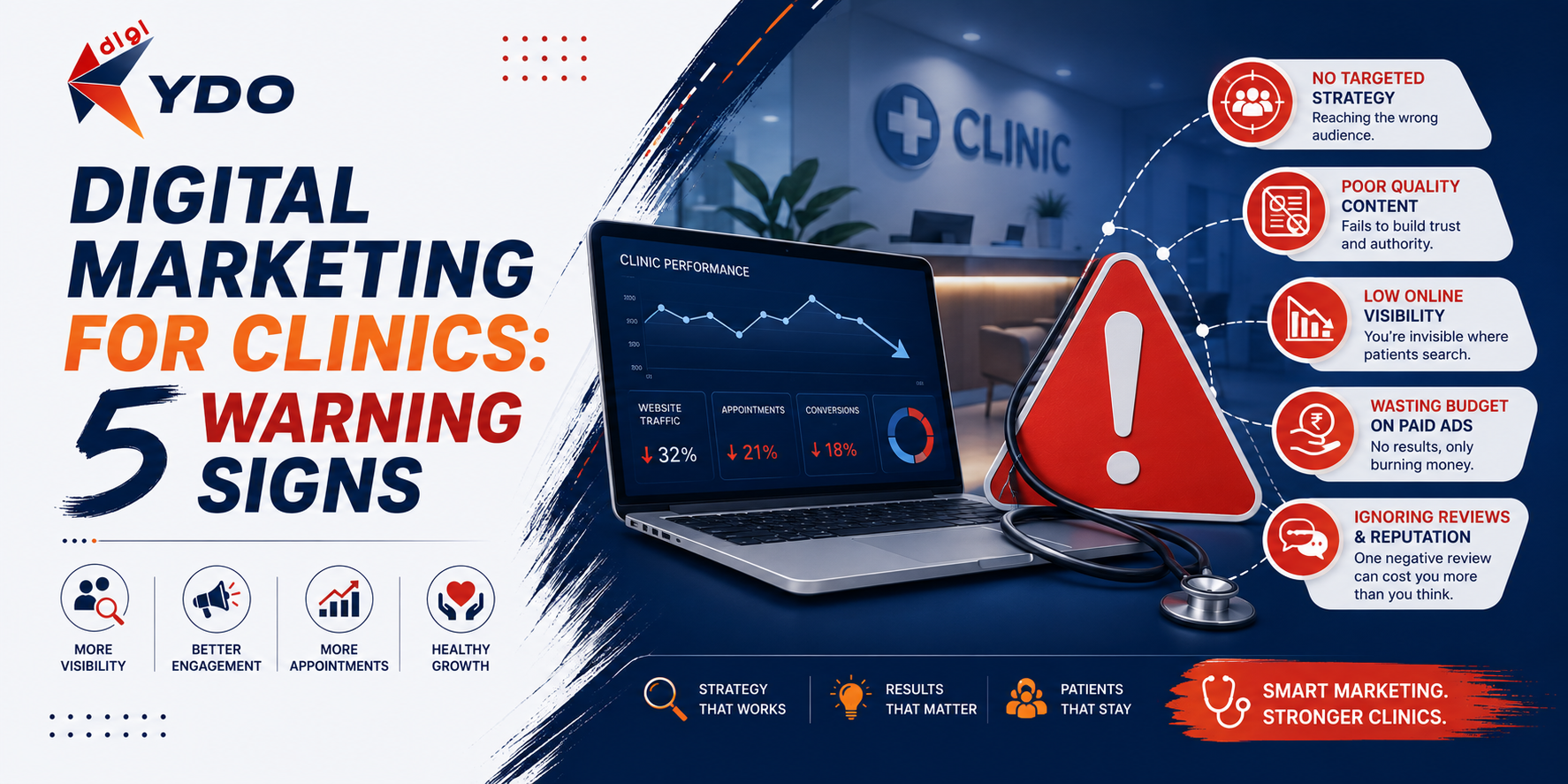
Digital marketing for clinics is unlike marketing for most other small businesses, because the rules restrict what you may say and the buyer is frightened. The five signs below are the ones that appear most often in practices that are running perfectly well clinically and losing patients for reasons nobody inside the building can see.
1. New patients say they found you somewhere you do not control
Listen at your own reception for a week. When a new patient says how they found you, note the answer.
If most of them name an aggregator or a directory rather than your own site or a recommendation, your visibility is rented. That arrangement works until the platform changes its ranking, raises its fee, or promotes the practice that pays more. You are a tenant in a market where you thought you were an owner, and the day the terms change you have no independent presence to fall back on.
The correction is not to abandon the aggregators, which genuinely produce patients. It is to build the visibility you own alongside them: your own site ranking for the conditions and procedures you treat, a properly maintained Google Business Profile, and a consultant profile good enough that people searching your name land on you first.
2. Searching your doctor's name returns somebody else's page
Try it now. Search the consultant's full name, then the common misspellings, then the name with your locality attached.
In a great many practices the first results are directory listings, an aggregator profile with outdated fees, an old association page, or a namesake in another city. Patients search doctors rather than institutions, particularly when they have been referred by name, and whatever appears is what they read.
This matters more in a clinic than in a hospital, because in a single-consultant practice the doctor is the brand. Dr Ravinder Gera, Gurgaon ENT Clinic, Charing Cross, Cure Centre and Smile Healing Academy each needed a credibility structure built around the practitioner rather than a hospital-style site: a full profile with qualifications and training, procedures explained in the consultant's own framing, and location and hours that leave no ambiguity.
If the pages that rank for your own name were written by somebody else, you have handed over the first impression.
3. Your listing details are wrong and you found out from a review
The most common version: a patient arrives on a Sunday because the Business Profile says open, finds a closed shutter, and leaves a one-star review about it. The second most common: the phone number on the listing rings in a room the practice moved out of.
This is not a small problem for a clinic. A diagnostic centre or a neighbourhood practice is chosen inside a radius you could cycle across, and the listing does most of the selling. For MCKV Diagnostic the listing, the test-wise pages, the early-morning and Sunday timings and the home-collection details are the primary asset, not the front page.
The signs that this needs attention are specific and easy to check: holiday hours never updated, no photographs of the actual entrance so a patient on the pavement cannot tell which door, reviews unanswered for months, and a complaint about waiting time sitting there with no reply. An unanswered complaint reads worse than the complaint.
4. The phone is your entire funnel and nobody knows what happens on it
In most clinics every path ends at one number, and nobody has ever examined it.
Ask three questions. How many calls are missed during OPD hours, and where do they go? Who answers, and what are they empowered to say about fees, timings and appointments? Is any enquiry recorded anywhere, so that next month somebody could say where the new patients came from?
If the answers are unknown, then every rupee spent on advertising is being spent into an unmeasured funnel. It also means the practice has no way to tell a good month from a lucky one.
This is also the point at which marketing meets administration. An appointment form asking eleven questions, a booking that requires a call back during the exact hours the patient is at work, an enquiry inbox nobody owns: these are administrative decisions with direct consequences for how many people become patients. We treat them as part of the website design work for a practice rather than as a technicality.
5. Nobody has checked what your social media is publishing
This is the sign clinics find most uncomfortable, and it is the most urgent one, because the risk is not a lost patient. It is a complaint to a council.
Medical advertising rules in India limit what a practitioner or a practice may claim. In practice, the material that most often crosses the line is produced with good intentions by whoever handles the clinic's social media, and it looks like this: before and after images, a grateful patient's message screenshotted and posted, a claim to be the best or the leading practice in a speciality, a promise about a result, a discount offer on a procedure, and a recovery story published with the patient's face.
Do not assume a patient's consent settles it. A signed release speaks to the patient's privacy, and your own professional conduct is a separate question with a separate answer. Treat them as two questions, and take the second one to your own adviser rather than to a consent form.
What holds up instead is explanation. What a procedure involves, from arrival to discharge. What the patient will feel afterwards and when they can return to work. Qualifications and training stated plainly. Answers to the questions people are too embarrassed to ask on the phone. A tour of the room where the procedure happens. None of it claims anything and all of it does the persuading, which is the argument we set out at length in social media for doctors.
If your account currently contains any of the material in the first list, that is the thing to fix this week, ahead of anything else in this article.
The sixth sign, for practices that do not fit the shape
Some practices do not have a visibility problem at all. They have a comprehension problem.
Rich N Rise works with children with ADHD and special needs, and the search behind it is not a symptom typed at eleven at night. It is a parent who has been worried quietly for months and has already been told several contradictory things by relatives. That parent is not comparing prices. Before ringing, they need to know what an assessment involves, who they will meet, how long a programme runs and whether they are about to be judged.
If your patients arrive hesitant rather than urgent, more advertising is the wrong lever. The work is written for the person deciding rather than for the person treated, and its job is to make the first phone call feel possible.
What to do about it
None of the five signs above requires a campaign to fix. In order: correct the listing, fix the phone and the enquiry path, build the consultant's own pages so the name search lands on you, remove anything non-compliant, and only then consider SEO work in Kolkata or advertising for the clinic.
The wider set of paths a practice can grow through is set out in our piece on patient acquisition strategies, and the whole category on our healthcare marketing page. If you have decided to bring somebody in, what to expect when hiring an agency covers the first ninety days, and our own front page sets out what we do as a digital marketing company in Kolkata.
Digi Kydo, 17R Dover Terrace, Ballygunge, Kolkata, West Bengal 700019. Call +91 98305 45687 or write to [email protected].
Frequently asked questions
How do I know if my clinic needs a digital marketing agency?
Five signals are worth checking. New patients mostly name an aggregator or directory rather than your own site or a recommendation. Searching your consultant's name returns somebody else's page first. Your listing details are wrong and you learned it from a review. Nobody knows how many calls are missed or where enquiries came from. And your social media contains material of the kind medical advertising rules are aimed at: before-and-after images, a patient's message screenshotted, a superiority claim, a promise of a result. The last of these is urgent regardless of anything else.
Can a doctor post patient testimonials or before and after photos?
Treat that as a question for your own professional adviser rather than for a marketing agency, and ask it before anything is posted rather than after a complaint. Testimonials, before and after imagery, superiority claims and promises about results are the four categories that draw attention, and a patient's consent should not be assumed to settle any of them, since your own conduct is a separate question from the patient's privacy. Procedure explanations, stated qualifications, pre-admission guidance and answers to common questions achieve the same persuasion without ever raising it.
Why do directory sites rank above my clinic's own website?
Because they are large, frequently updated, and structured around exactly the searches patients make, while most clinic sites have one thin page per service and no proper profile for the practitioner. The correction is to publish what the directory cannot: a complete consultant profile with qualifications, training and areas of practice, procedure pages written in the doctor's own framing, and accurate location and timing information. A well-built profile page usually outranks a directory entry for the doctor's own name.
What should a clinic fix before spending on advertising?
The listing first, including holiday hours, the correct phone number, photographs of the actual entrance and replies to existing reviews. Then the enquiry path: who answers the phone, what happens to missed calls and whether any enquiry is recorded. Then the practitioner's own pages. Advertising into a wrong opening time or an unanswered phone converts spend into bad reviews rather than into patients.
Is digital marketing for a clinic different from marketing for a hospital?
Substantially. A clinic is chosen inside a small radius, on convenience, timing and the practitioner's name, so the listing, the profile and the phone do most of the work. A hospital is chosen on speciality and consultant, draws from a much wider catchment, and depends heavily on referring physicians as well as on patients. Applying a hospital's department-led approach to a single-consultant practice produces a site that answers nobody's search.